Quality Magazine has published a feature on BYOP — “Bring Your Own Projector” — a machine vision camera developed at the University of Kentucky that integrates a complete HDMI receiver and transmitter alongside the image sensor on a single FPGA. Connect any HDMI projector and the system becomes a structured-light 3D scanner: no external trigger box, no frame grabber, no custom synchronization cabling.
On September 18, Vision Systems Design followed with its own piece by senior editor Jim Tatum. “This system is the culmination of years of research and development into structured light imaging,” I told them, “and by making commodity projector synchronization so easy, I hope it unlocks years more of technological improvements in SLI.”
Why put the camera in the video path
Structured-light scanning projects a sequence of patterns onto an object and photographs each one, and the measurement is only as good as the synchronization between the two. Conventionally that means a trigger generator, a cable harness, and a calibration step for the delay between them — an assembly that has to be reworked whenever the projector, the frame rate, or the pattern set changes. Because BYOP sits in the video path rather than beside it, the projected frames and the camera's exposures come from the same signal, inside one device. The synchronization problem is removed rather than managed.
Keeping time with a PC that makes no promises
A computer's graphics hardware is not a real-time system: it may hold an image on screen for an extra refresh, or deliver the next one late, and nothing in the video signal announces which has happened. The camera therefore watches the top-left pixel of every incoming frame. A change in that value means a genuinely new pattern has arrived and the frame should be captured; no change means the host repeated itself. That sampled value is embedded in the frame header sent back to the PC, so the captured sequence can be lined up against the pattern sequence that was played.
Commodity projectors, at their own native rate
The point of the design is access. Structured-light systems are conventionally built around dedicated projection light engines — metrology modules made in small volumes, at prices that dominate the cost of the instrument. Commodity projectors are mass-produced, bright, available in a wide range of fields of view and throw distances, and, with LED illumination, last tens of thousands of hours. On power-up the camera reads the connected projector's EDID and drives it at a mode that projector itself advertises — DLP, LCD, or LCoS. Where a host PC is in the path, the camera serves an EDID of its own, offering the projector's mode list narrowed to the modes the camera can also receive, so the operator only ever sees display modes known to work end to end.
The board can also generate its own pattern sequences internally and drive the projector directly at up to 120 frames per second — the native rate of the large, inexpensive installed base of 3D-Ready DLP projectors built for shutter-glasses stereo. In that mode the entire structured-light loop runs on the camera itself, with a computer needed only to collect the resulting images.
The hardware
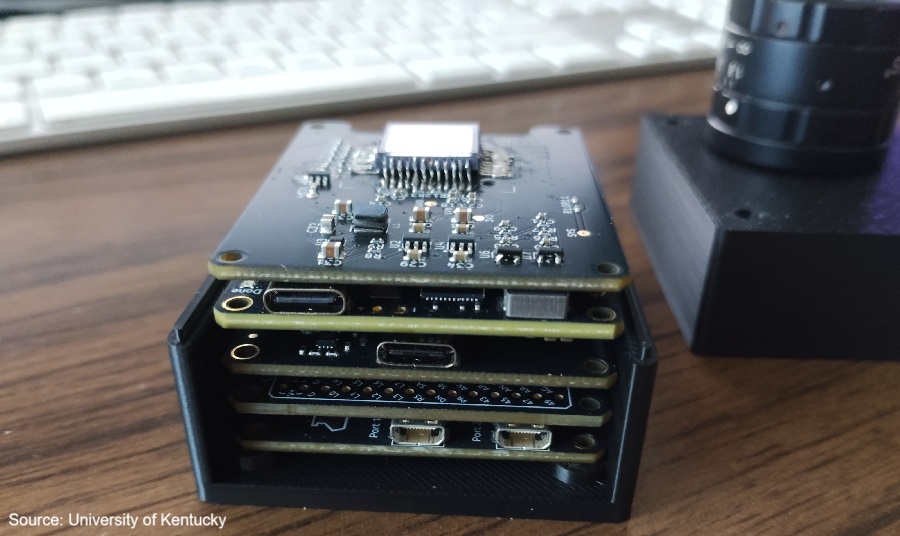
The camera is built around the onsemi PYTHON 1300, a global-shutter CMOS sensor with 1280 × 1024 resolution and 4.8 µm pixels, reading out over four LVDS channels at 720 Mbit/s each and delivering 10 bits of depth. It streams 120 frames per second over USB-C at full resolution and full bit depth — no cropping, no windowing. On slower USB 2.0 connections it need not stream at all: frames are captured into on-board DDR3 as they are projected and downloaded afterwards, so scan speed is set by the HDMI frame rate rather than by the host link. Three of the four boards in the stack are commercially available Alchitry parts; the sensor board was designed for this project.
Because the HDMI path runs through the camera with separate input and output ports, units can be chained — the host drives the first, each forwards the video onward, and every camera in the chain keys to the same frames. That makes active stereo, multi-view capture, and extended-baseline geometries straightforward to assemble.
The published groundwork
The architecture was proposed and argued for in our earlier work; what is new is that it has been built and measured. The relevant background:
- M. P. Ruffner, Y. Yu and D. L. Lau, “Structured light smart camera for spatial augmented reality applications,” Proc. SPIE 10932, 109320J (2019). doi:10.1117/12.2508553
- M. P. Ruffner, “Design of a Machine Vision Camera for Spatial Augmented Reality,” MSEE thesis, University of Kentucky (2018). uknowledge.uky.edu/ece_etds/129
- Y. Yu, D. L. Lau, M. P. Ruffner and K. Liu, “Dual-projector structured light 3D shape measurement,” Applied Optics 59(4), 964–974 (2020). doi:10.1364/AO.378363
- Y. Yu and D. L. Lau, “3D scanning by means of dual-projector structured light illumination,” Proc. SPIE 10932, 109320M (2019). doi:10.1117/12.2510990
Next on the list is deflectometry — reflecting the pattern off a specular surface rather than projecting it onto a diffuse one — using commodity 200–210 Hz gaming monitors, where the display meets the PYTHON 1300 at the top of its own range. That is intended future work, not a capability of the board today.
Read it in Quality Magazine → Read it in Vision Systems Design → ← All posts